SSD Endurance and Wear Management in KV Cache Offload Deployments
SSD endurance, not just capacity, determines whether KV cache offload saves money at scale.
NVMe and tiered storage improve LLM inference throughput by retaining reusable KV cache beyond GPU HBM and CPU DRAM, often avoiding costly prefill recomputation. But SSD endurance and wear management decide whether those gains stay reliable and worth the cost at scale. KV offload must be designed around sustained write pressure as well as storage capacity, with I/O design, compression, NAND selection, and firmware treated as parts of the same system.
Why NVMe SSDs are now load-bearing infrastructure in LLM serving
Long-context serving needs more room for cache than the memory tiers above NVMe have. Tutti notes that roughly 2 TB of DRAM retains only around five minutes of KV cache for long-running conversations. Agentic workloads and long idle sessions require cache to be retained beyond that window. NVMe therefore serves as a structural capacity tier.
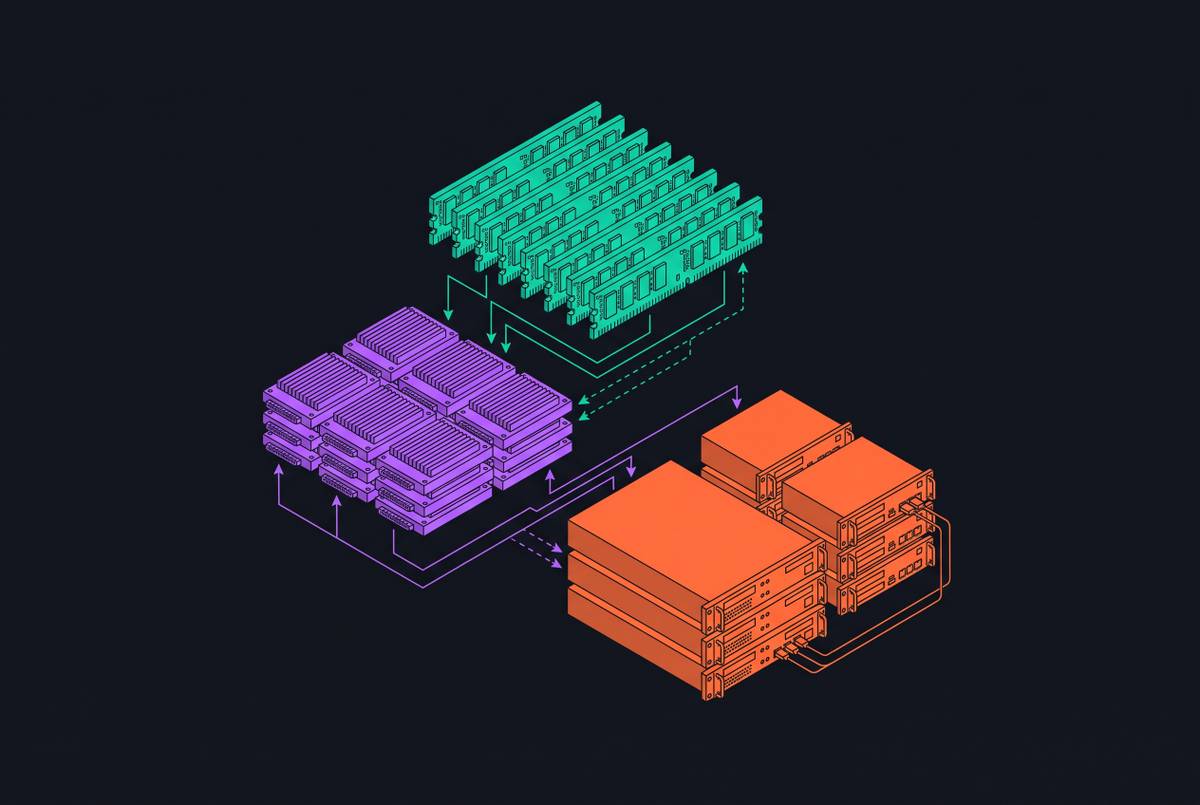
The standard hierarchy places GPU HBM above CPU DRAM and NVMe SSDs. NVIDIA's CMX Context Memory Storage Platform, formerly ICMSP, announced at CES 2026, formalizes this pattern by moving cold KV blocks to NVMe through BlueField-4 DPUs. Storage infrastructure built for this task, such as Open Lake's, also manages cache across these tiers. Loading a long prefix from NVMe is routinely faster and cheaper than recomputing prefill at current context lengths. But that saving depends on a storage tier that can take repeated eviction traffic without wearing out.
What KV cache traffic actually does to an NVMe drive
KV offload looks sequential at the application layer but can reach the SSD as fragmented, interleaved I/O. Prefill produces large write bursts, while decode repeatedly reads accumulated KV cache. This write-then-read cycle repeats across sessions, so the drive gets dense mixed traffic in place of a simple stream of retained files.
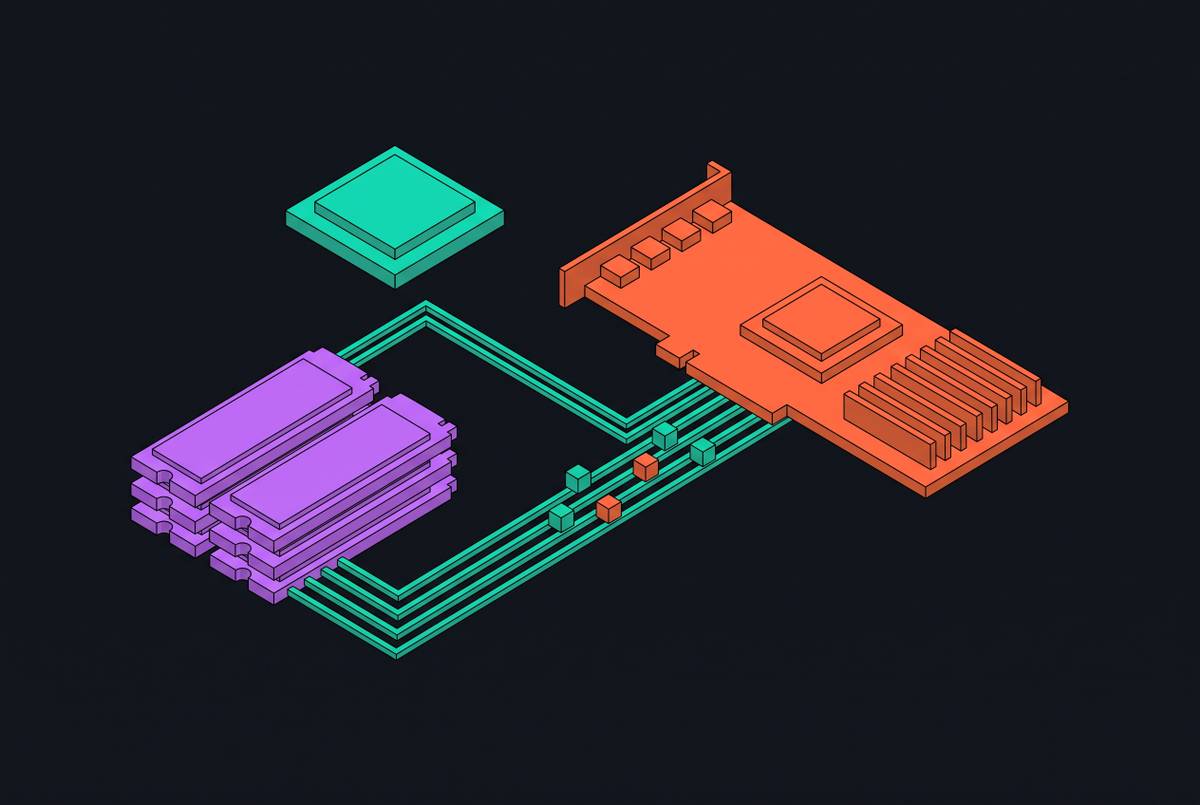
DUAL-BLADE identifies page-cache thrashing, software stack overhead, and loss of sequential locality in naive offload. Cached pages can be evicted before reuse, while requests traverse VFS, the filesystem, the block layer, and the device driver. Linux's multi-queue block layer, blk-mq, distributes requests across NVMe queues and can fragment a contiguous KV stream into a non-sequential arrival order. Tutti reports major GPU stalls caused mostly by tiny random I/Os that need the CPU to step in at every transfer. For the drive, this fragmentation means that write requests arrive as many separate events for the flash translation layer, or FTL, to track.
Quickly evicted blocks, blocks retained across idle sessions, and blocks invalidated asynchronously across workers and tenants can share NAND blocks. Reclaiming space then requires the drive to move still-valid data before erasing blocks. Those internal rewrites create write amplification, so the NAND absorbs more bytes than the host sends.
How NAND cell type sets the endurance ceiling for a given workload
NAND selection establishes the raw endurance budget before the first inference request runs. TBW, or terabytes written, expresses a lifetime write cap, while DWPD, or drive writes per day, expresses a sustained write-rate allowance. Both matter because KV eviction traffic is continuous as well as voluminous. A drive can have plenty of room for the cache but too little write endurance to keep up with it.
High-performance TLC NVMe is rated above 3 DWPD, standard enterprise TLC runs 1–3 DWPD, and capacity-class QLC typically falls below 0.5 DWPD. Under sustained write load, TLC also tends to incur substantially lower write amplification than QLC. The write amplification factor, or WAF, is the ratio of bytes written internally to NAND to bytes supplied by the host. A higher WAF consumes more of the underlying endurance budget for the same useful cache traffic.
QLC's density and lower cost per terabyte make it attractive for read-heavy inference storage, where model weights are read repeatedly with few rewrites. KV offload adds sustained writes to this capacity tier, which changes how its cost should be weighed. Background garbage collection and amplified writes also generate heat, which can push a drive into thermal throttling after minutes of heavy use. As bandwidth drops from its peak to a much lower sustained rate, a low purchase price tells only part of the story of cost per token.
The production failure modes engineers actually encounter
The most alarming failure begins as a latency cliff during serving. When writes keep coming, garbage collection must block foreground I/O to get its work done. Tail latency then spikes abruptly rather than degrading gently, putting SLOs at risk. A storage tier that appeared adequate at peak bandwidth becomes unpredictable precisely when requests depend on it.
DUAL-BLADE reports latency that is hard to predict and high software overhead when naive file-based offload runs under memory pressure. These are also conditions that expose the drive to garbage-collection pressure, although software overhead and NAND maintenance are distinct problems. The py-kvcache study found that cache performance depends on transfer granularity, intermediate memory use, and when transfers enter the request schedule, as well as device bandwidth. When a drive falls below the bandwidth that schedule assumes, more than one slow transfer is at stake.
Premature failure is the second consequence. With continuous KV eviction, a drive chosen for read-heavy enterprise traffic can use up its TBW budget long before the end of its expected service life. The remaining failure mode is financial, namely avoidable overprovisioning. Buying more drives or switching to higher-endurance TLC without measuring the actual write pattern can waste money and leave the cause in place.
How software I/O design reduces the write pressure the drive actually sees
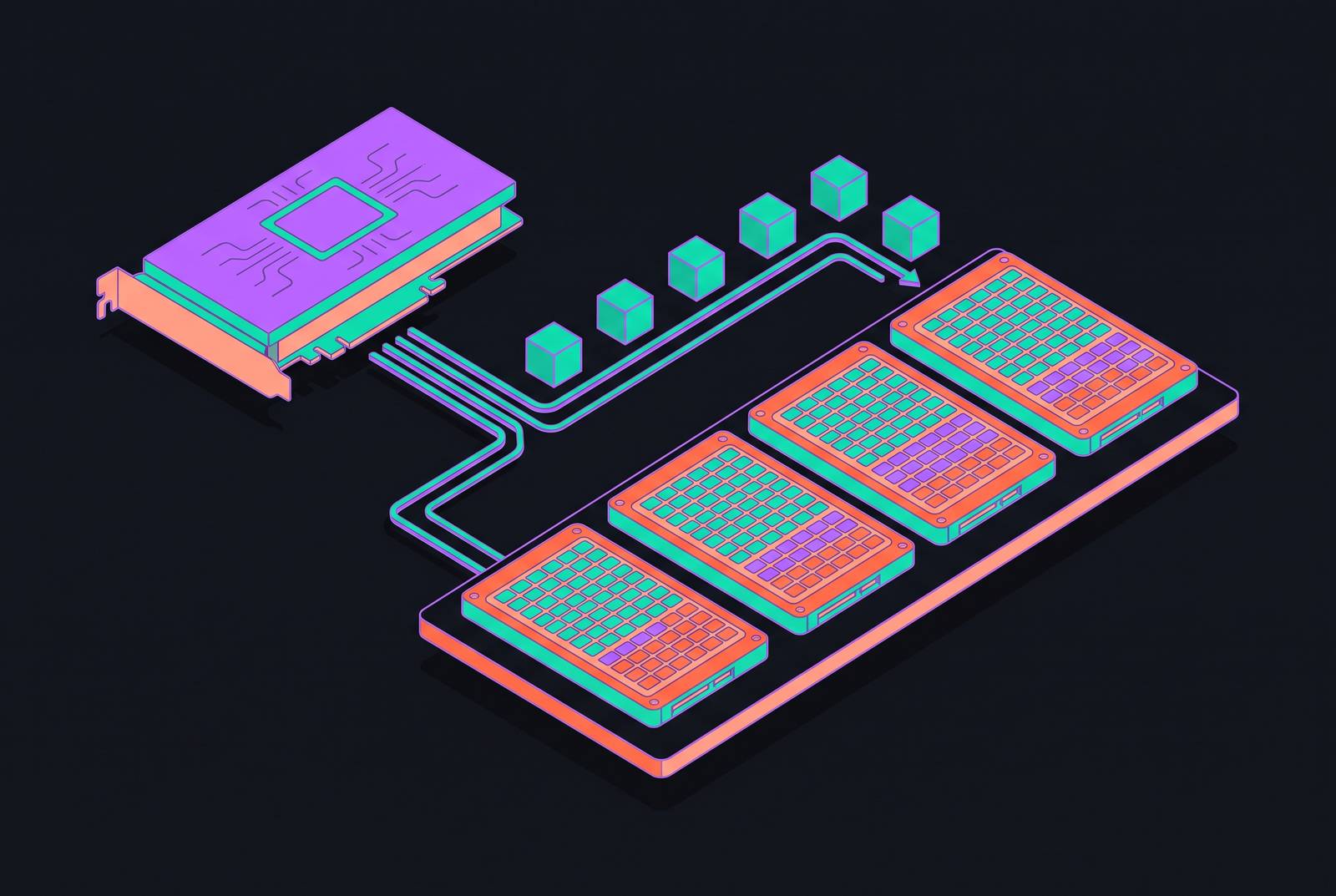
The write pattern reaching NAND is partly a software artifact, so mitigation can begin before a different drive is purchased. Tutti builds a GPU-centric KV cache object store that eliminates CPU intervention from the critical data and I/O control paths between HBM and SSDs. Consolidating many tiny random I/Os into bulk transfers gives the FTL a less fragmented stream to manage. Its GPU io_uring supports asynchronous GPU-direct object I/O and slack-aware scheduling, reducing out-of-order arrivals while avoiding GPU resource contention. The endurance benefit comes from how writes reach the controller.
DUAL-BLADE has a page-cache path and an NVMe-direct path. Tensors that exceed the page-cache budget use contiguous logical block address regions on the direct path, restoring sequential locality. Its adaptive pipeline parallelism overlaps storage I/O with GPU DMA and smooths the bursty write profile that creates garbage-collection pressure. A steadier stream gives the FTL more opportunity to reclaim space in the background. Open Lake's KV storage design similarly treats sequential locality and write amplification in the NVMe tier as storage-system concerns.
py-kvcache addresses the surrounding schedule through asynchronous direct I/O, bounded shared staging, and preloading while requests are still queued. Reducing decode-phase read storms limits disruptive read-write interleaving and the associated garbage-collection overhead. For short prefixes on fast GPUs, recomputation can beat loading, so a policy that skips unnecessary NVMe caching also avoids the corresponding writes.
How compression cuts the bytes written to NAND before they reach the drive
Data reduction manages wear at a different point from I/O scheduling. Scheduling changes the shape of traffic, while compression reduces the payload that must be stored. At otherwise comparable write amplification, fewer host bytes translate proportionally into fewer NAND writes. This makes compression an endurance-budget multiplier as well as a transfer optimization.
Switching KV storage from BF16 to FP8 halves the byte volume written on each eviction. NVFP4 reduces KV cache memory further than either BF16 or FP8, with negligible quality loss for most production workloads. Lossless compression offers another route by preserving tensors bitwise while shrinking their stored representation. SplitZip (2026) achieves compression and decompression throughput sufficient to keep pace with prefill KV production on real BF16 activation tensors. It also delivers end-to-end TTFT and KV transfer improvements in prefill-decode disaggregated deployments.
SplitZip extends to FP8 KV caches and provides further compression over native E5M2 representation. ZipServ (2026) applies lossless compression to model weights and activations, reducing model size and accelerating inference end-to-end. Its relevance also includes bandwidth contention because weight loading competes with KV transfers for NVMe access, although weight reads are not themselves NAND writes. Together, quantization and lossless compression can extend drive service life or provide headroom for a less expensive endurance tier.
How drive firmware and controller intelligence affect wear under KV workloads
NAND type does not fix WAF by itself. The FTL determines how writes are consolidated, where data is placed, and how garbage collection reclaims space. Better firmware can reduce internal rewriting on the same NAND through smarter garbage collection and dynamic channel rebalancing. Enterprise controllers also use dynamic wear leveling and predictive error handling, but their capabilities vary across product tiers. Headline DWPD ratings do not fully describe that behavior under mixed-lifecycle KV traffic.
A new generation of controllers has AI instruction sets and dedicated compute cores for machine-learning-based management. These controllers can optimize placement, rebalance channel workloads, adapt wear leveling, and predict errors. Those functions address the irregular retention and write frequencies that make KV offload difficult for the FTL. Engineers should therefore evaluate drives under KV-representative write patterns rather than treating the specification sheet as a complete endurance model. Sustained behavior matters more than a peak result that disappears once background work accumulates.
Thermal headroom belongs in the same evaluation because sustained traffic causes throttling when cooling is inadequate. Adequate cooling and a drive suited to the thermal load are prerequisites for consistent SLO performance. NVIDIA's ICMSP architecture assigns I/O scheduling to BlueField-4 and uses hardware-accelerated cache placement to reduce metadata overhead and data movement. This complements drive firmware by reducing reliance on CPU-mediated small random I/O rather than replacing the need for sound wear management inside the SSD.
Designing the NVMe tier as an endurance-aware system rather than a capacity decision
An endurance-aware NVMe tier joins NAND selection, I/O architecture, data reduction, and admission policy into one budget. TLC or QLC sets the raw wear allowance, but software controls how much of it useful cache traffic uses. Kernel-bypass paths, contiguous LBA mapping, and GPU-native I/O reduce fragmentation and internal rewriting. Quantization and lossless compression reduce the bytes that enter that path, while admission policy excludes caching work that would not benefit the request. The resulting design targets useful reuse per NAND byte written.
Parallelism also affects durability. NVIDIA's ICMSP guidance recommends spreading traffic and wear across multiple drives in place of a single large drive that takes all the wear. Capacity savings hold up only if the chosen NAND and controller can handle the resulting write pressure. In Open Lake's infrastructure design work for LLM inference, this connects drive selection and endurance budgeting to the same engineering problem as GPU memory hierarchy and KV placement. A cost-optimized serving configuration remains practical only if its storage layer can sustain the workload without unexpected replacement and reprovisioning.
That budget must remain visible after deployment. Operators should track TBW consumed, WAF estimates, and thermal state alongside GPU utilization and TTFT. These measures show how host traffic wears the drive and what causes latency to get worse before the drive fails. Endurance management is therefore an ongoing production obligation after the NVMe tier is installed.